Case study · one building, three courts · occupied Mariupol
Special proceeding → appeal → federal cassation
They fought the seizure in the occupier’s own courts. They lost three times.
Sixty residents of a nine-story building on Metallurgov AvenuePre-war (UA)проспект МеталургівOccupation (RU)проспект Металлургов spent nearly two years losing the same case at three levels of Russian courts. The losing is the point. To deny them, the courts had to enter into the record the entire administrative sequence that took their homes — and that record now contains a demolition contract dated two years after the building was already rubble. A court file is harder to dismiss as activist reconstruction when the occupier wrote it.
60residents filed
the collective claim
the collective claim
3 / 3courts ruled
against them
against them
22of 60 had compensation
approved — 38 had not
approved — 38 had not
~103M ₽demolition contract dated
2 yrs after the demolition
2 yrs after the demolition
45k vs 53kcomp rate vs market floor
per m² (₽)
per m² (₽)
RD4U · A3.6
Rome Statute · 8(2)(a)(iv)
Rome Statute · 8(2)(b)(viii)
00 · The address
A nine-story building in the center of the city
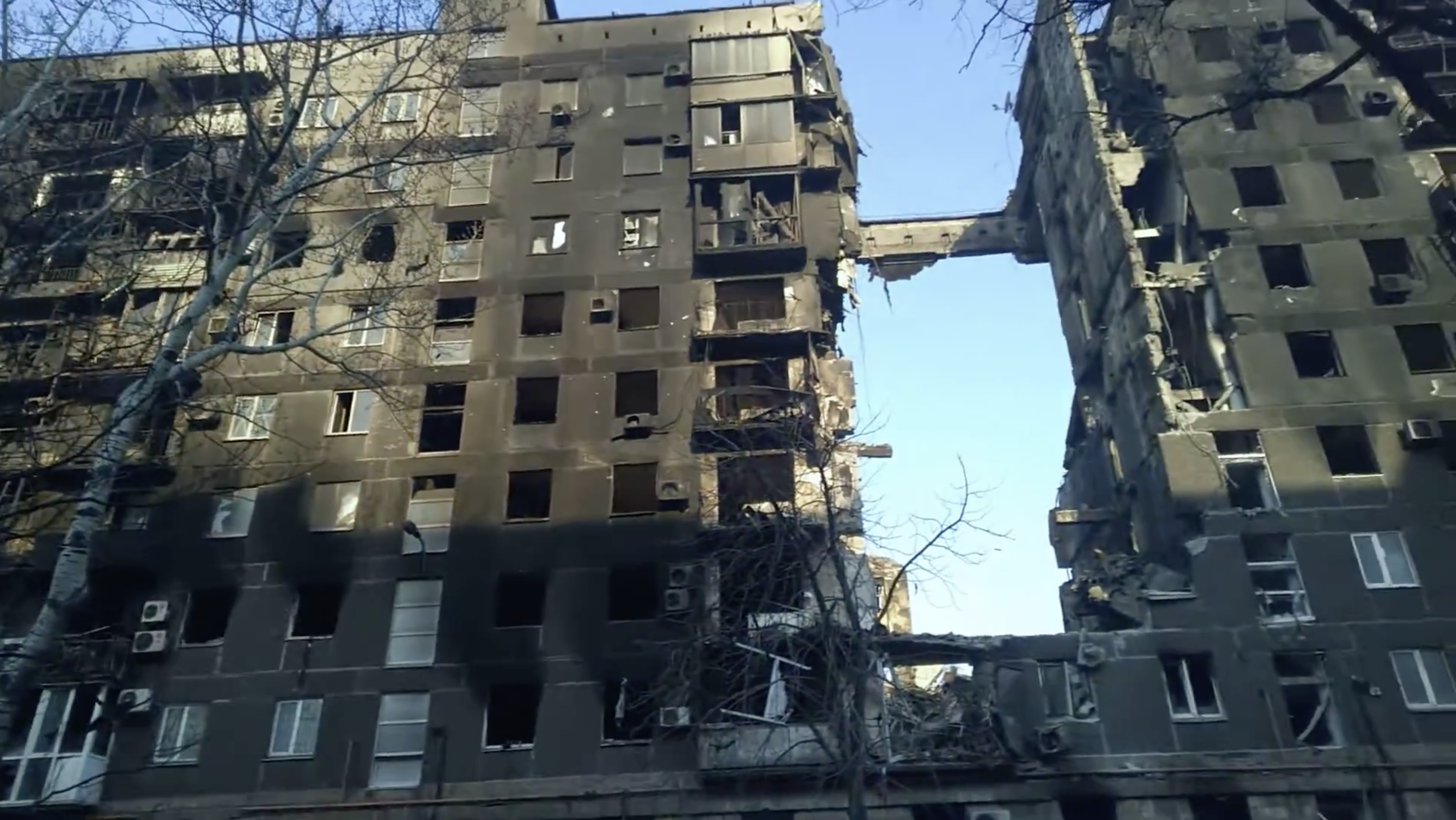
The building stood at Metallurgov Avenue, 47Pre-war (UA)проспект Металургів, 47Occupation (RU)проспект Металлургов, 47, in central Mariupol — about 800 metres from the Drama Theatre, beside the central market, on one of the city’s longest avenues where it crosses Soborna StreetPre-war (UA)вулиця СоборнаOccupation (RU)улица СоборнаяRenamedOccupation authorities renamed it Varganova Street, after Soviet architect Yevgeny Varganov. Nine floors, two entrances, ordinary Soviet-era housing. After the siege it became one of the war’s most recognizable images, in photographs by Russian military correspondentsNo other journalists were in the city during the siege, apart from Ukrainians Mstyslav Chernov and Yevhen Maloletka, whose footage became the basis of the documentary 20 Days in Mariupol.: a single entrance section punched out through the middle, the rest still standing. People kept living in it, and in its basement, after the fighting passed.
01 · From above · three dates
Intact, then hit, then gone
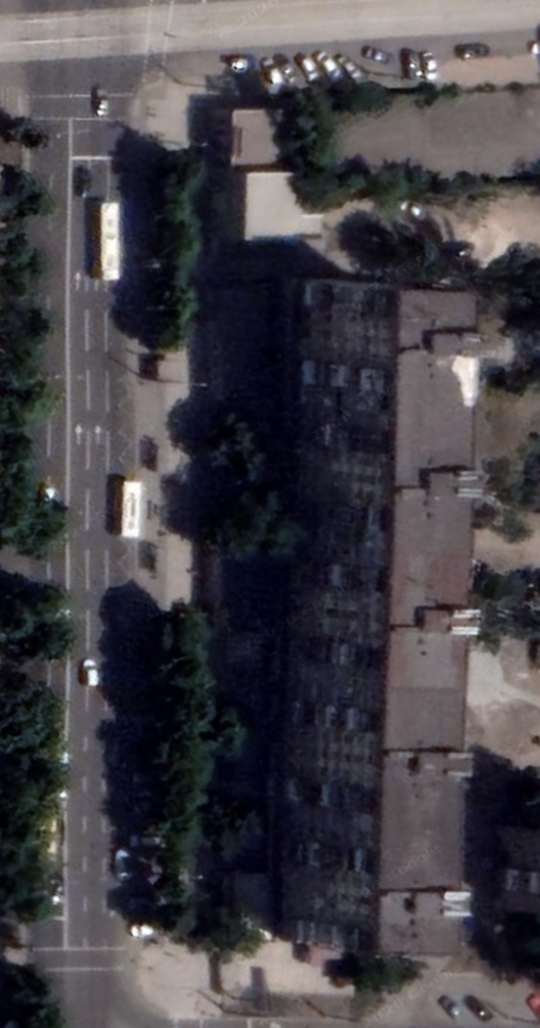
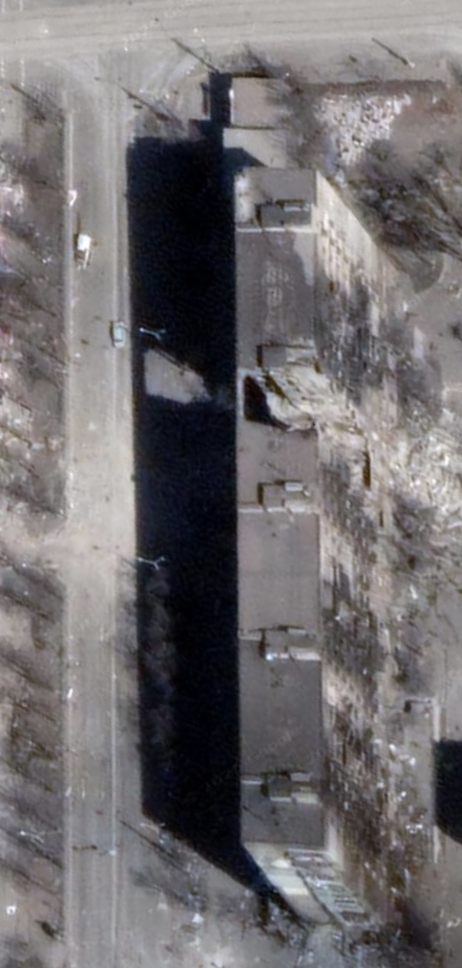
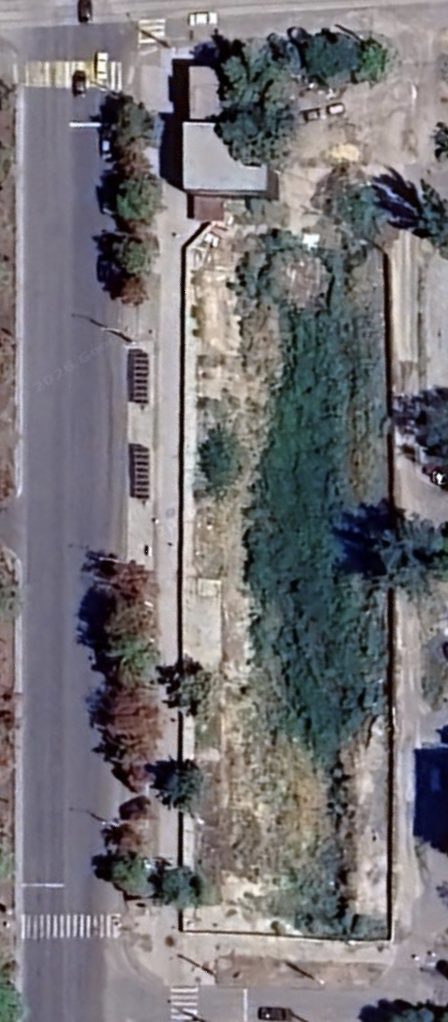
The same footprint, from orbit, across four years. In June 2021 the long apartment block sits whole behind its row of street trees. By March 2022 one entrance section has imploded — the dark collapsed gap is visible from space, consistent with a 17 March 2022 explosion the residents and local press both describe. By August 2024 the building is gone and the lot is cleared to bare ground; the street trees survive the building they once shaded.
Jun 2021 · intact
Mar 2022 · entrance imploded
Aug 2024 · cleared lot
The same March 2022 moment, from the street. Two stills from independent footage show the identical entrance section the satellite frame above captures from orbit — the gap punched straight through the building, fire-scorched concrete and exposed rebar on either side, residents’ balconies and air-conditioning units intact one floor away from the collapse.
Mar 2022 · street level
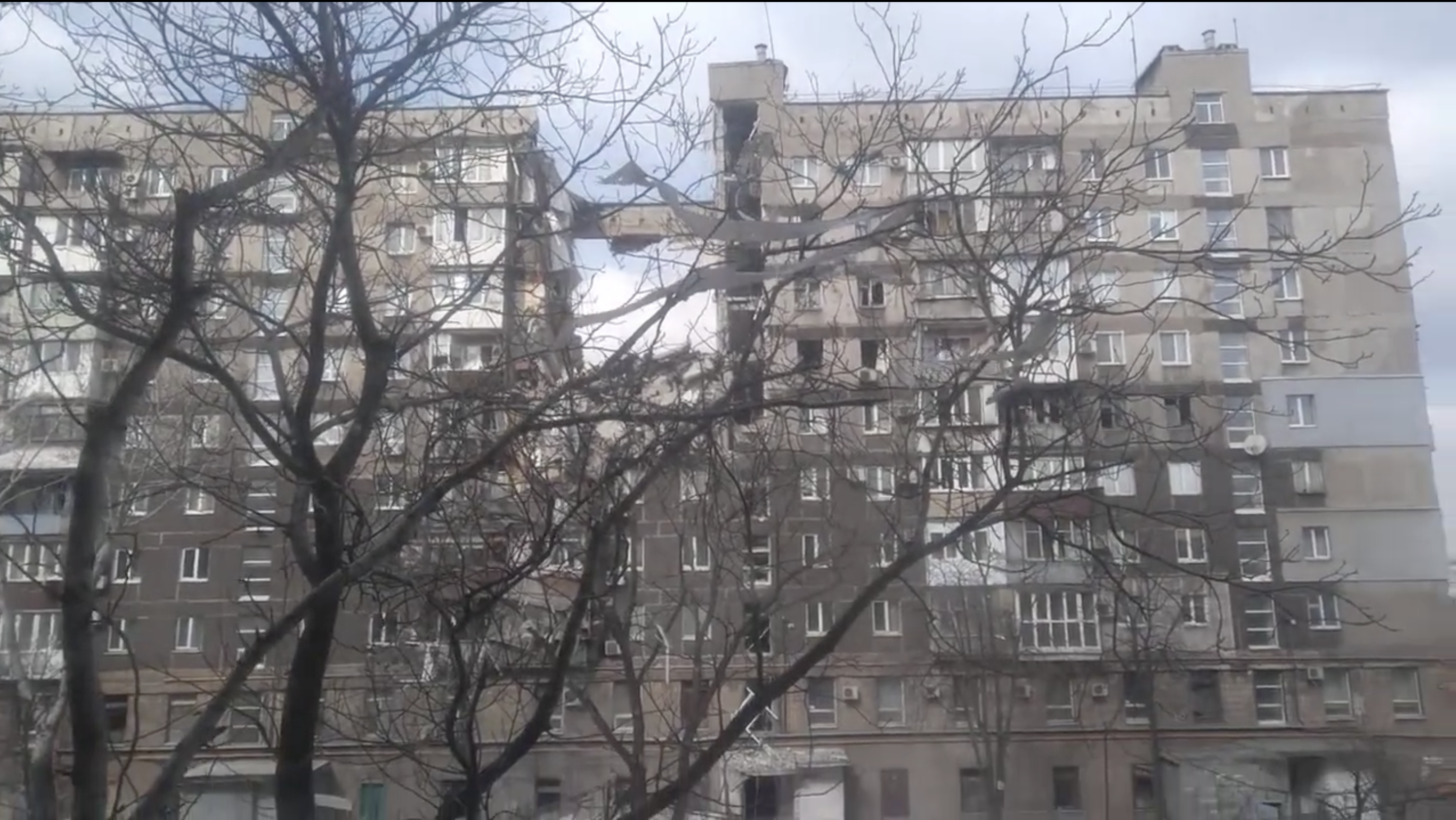
Mar 2022 · closer angle
02 · The litigation ladder
The same case, lost at three levels
The building’s homeowners’ association — HOA “Troianda-M”ТСЖ «Троянда-М» — товарищество собственников жилья, the post-2022 re-registration of the same pre-war Ukrainian condominium association — had to register as a Russian legal entity in July 2024 merely to be recognized as a party. It then carried the residents’ claim up the full ladder of Russian civil courts, and lost at every rung.
| Court | Case No. | Presiding / reporting judge | Date | Result |
|---|---|---|---|---|
| Zhovtnevyi District Court (DNR) | 2-259/2025 | Yulia SazonovaСазонова Юлия Юрьевна | 21.07.2025 | Denied |
| DNR “Supreme Court” (appeal) | 33-2575/2025 | N. N. GuridovaГуридова Н.Н. (reporting judge; presiding: Олейникова В.В.) | 13.11.2025 | Upheld below |
| 2nd Cassation Court of General Jurisdiction (federal) | 8Г-12687/2026 | Tatiana VasilyevaВасильева Татьяна Геннадьевна | 05.05.2026 | Denied |
Unified case ID 93RS0006-01-2024-005922-91 threads through all three levels. Press reporting (Agents.Media, 27.02.2026) described the residents as filing “with the Supreme Court” — but the cassation court’s own docket (case 8Г-12687/2026, captured directly, linked above) shows the complaint was received and registered by the 2nd Cassation Court of General Jurisdiction on 06.04.2026, the standard routing for a civil cassation complaint in this system, and decided there on 05.05.2026. That docket carries its own dedicated field for matters forwarded to or from Russia’s actual Supreme Court; it reads “none.” Domestic remedies end at this federal cassation stage — there is no evidence of a further escalation.
The appellate court’s stated ground for denial is worth reading slowly, because it is circular. Before HOA “Troianda-M” re-registered in 2024, the demolished property had been formally assigned to the Public-Law Company “Unified Construction Client”ППК «Единый заказчик» — публично-правовая компания, the state demolition operator. The court held that this custodial assignment predates the residents’ association regaining the legal standing to contest it — so the very gap the occupation created, between tearing the building down and letting the residents organize to object, became the reason their objection arrived too late.
03 · The record, in its own words
The paperwork the denial had to spell out
Court rulings are usually read for their holding. This one is more useful read for its findings of fact: to explain why the residents lose, the appellate court laid out the full administrative sequence that produced the loss. Every date below is drawn directly from the captured ruling text.
Feb–Mar 2022
Building sustains combat damage in the siege; one entrance section destroyed by an explosion residents date to 17 March 2022. People continue living in the building and its basement.
29.09.2022
Commission conclusion No. 118 declares the building unfit for habitation and condemns it for demolition — under a procedure (DNR “State Defense Committee” Resolution No. 162Постановление «ГКО ДНР» № 162 от 23.07.2022) the residents say was never followed: three of the case documents list three different commission rosters. The same day, DNR “State Defense Committee” Distributive Order No. 56Распоряжение «ГКО ДНР» № 56 от 29.09.2022 names this exact address — prosp. Metallurgov, 47 — in its 177-building Mariupol demolition schedule (DNR MinStroy Unified Demolition Register, row 277; geoblocked DNR portal, captured via VPS).
10–25.12.2022
Building physically demolished — dated to the day by the residents’ own contemporaneous video, which shows it coming down section by section, only rubble left by 20 December.
26.07.2023
Formal act recording the completed demolition names OOO “RKS-NR”ООО «РКС-НР» as the party that carried out the dismantling.
07.09.2023
Decree of the Head of the DNR No. 291Указ Главы ДНР № 291 от 07.09.2023 grants the developer municipal land parcels without auction — one of them 3,136 m² at the Metallurgov intersection — for the investment project “Novoe vremya 2”«Новое время 2» — «New Time 2». Residents say their address was “annulled” at this point.
28.10.2024
The collective lawsuit is filed.
27.12.2024
A demolition contract between the Unified Construction Client and RKS-NR, worth roughly 103 million rubles, is signed — and disclosed by the judge in an April 2025 hearing. Its date is two years after the building the residents’ own video had already shown reduced to rubble in December 2022.
Eight named dead
At least eight named residents of this address are recorded killed during the siege (Feb–Mar 2022), per the Mariupol Destruction and Victims Map, cross-referenced against Telegram channel t.me/mariupolRIP and memorial.ua. Two courtyard burial sites are independently documented: Фёдорова Надежда (b. 1938, killed by shelling 01–03.03.2022) was buried next to the building, wrapped in a rug — “reburial status unknown”«похоронили возле дома, в ковре. Перезахоронение неизвестно»; Харакоз Наталья Георгиевна (b. 1935, a writer and journalist known in Mariupol, died 29.03.2022 of stress and lack of medication) was buried in a common grave in the courtyard, later exhumed and reburied at Starokrymske cemetery — locatable only because a neighbour tucked a note with her name into her pocket before the mass burial.
| Name | Died | Circumstances | Source |
|---|---|---|---|
| Фёдорова Надежда | 01–03.03.2022 | Shelling blew out windows; injured by glass shards; heart stopped. Buried beside the building, wrapped in a rug; reburial status unknown. | memorial.ua |
| Харакоз Наталья Георгиевна | 29.03.2022 | Died of stress, conditions, lack of medication. Buried in a common grave in the courtyard; later reburied at Starokrymske cemetery. | Granddaughter (direct) + t.me/mariupolRIP/25434 |
| Тёрин Александр Евгеньевич | siege period | Body found while clearing rubble. | t.me/mariupolRIP/19202 |
| Тёрина Елена Александровна | siege period | Body found while clearing rubble. | t.me/mariupolRIP/19202 |
| Иванов Максим Владимирович | 17.03.2022 | Killed in an airstrike, together with his mother Людмила. | t.me/mariupolRIP/19075, /44185 |
| Паскаль Мария | 24.03.2022 | Killed by shelling while cooking in the courtyard (married couple with Галушко Андрей, below; same death/burial address). | Neighbours (direct) + t.me/mariupolRIP/30852 |
| Галушко Андрей | 24.03.2022 | Killed by shelling while cooking in the courtyard (married couple with Паскаль Мария, above). | Neighbours (direct) + t.me/mariupolRIP/30852 |
| Горлачова Раиса Дмитриевна | 17.03.2022 | — | t.me/mariupolRIP/44164 |
Ivanov’s mother, Людмила, is named as also killed 17.03.2022 in the same airstrike but has no row of her own in the source. The underlying spreadsheet and individual Telegram/memorial.ua pages have not yet been hashed into this project’s standard chain of custody — treat as sourced but not yet archive-verified.
The detail that does the work
A contract to demolish a building, signed two years after that building was demolished, for 103 million rubles. The occupation court did not hide it — a judge read its date into an open hearing. The residents’ lead representative, who had filmed the actual demolition in December 2022, was in the room to hear a contract dated December 2024 described as its legal basis. The sequence is not alleged by the dispossessed; it is recorded by the court that ruled against them.
Two further irregularities sit in the same file. The technical report underlying the condemnation was challenged by residents for carrying no approval signature; the appellate court noted the objection and relied on the report anyway. And the condemnation paperwork names three different commission rosters across three documents — a composition DNR “State Defense Committee” Resolution No. 162 (the governing demolition procedure) does not permit. The appellate court (case 33-2575/2025) rejected the underlying claim — but without engaging the three-rosters discrepancy itself, on the narrower ground that “the case file contains no evidence the owners sought to take part” in the commission. A related complaint, that the building’s balance-holder was excluded from the commission, was rejected too, on a technicality: at the date of conclusion No. 118 (29.09.2022) the building was assigned to PPK “Edinyi zakazchik,” and TSZh “Troianda-M” did not yet exist.
04 · The contractor, named on camera
“KrashMash demolishes Metallurgov 47”
Who physically demolished the building is established directly, from a video uploaded on 14 December 2022 titled “МАРИУПОЛЬ! КРАШМАШ СНОСИТ ЗНАМЕНИТУЮ МНОГОЭТАЖКУ НА МЕТАЛЛУРГОВ!” (“Mariupol! KrashMash demolishes the famous high-rise on Metallurgov!”), carrying on-screen text reading “KrashMash demolishes Metallurgov 47”«…рашМаш» сносит Металлургов 47. The video’s own description dates the start of work to 10 December: “The famous building at Metallurgov 47, whose photographs are known worldwide, has gone under demolition. The company ‘KrashMash’s multi-metre excavator began work on 10 December.”«Знаменитое здание на Металлургов 47, чьи фотографии известны всему миру пошло под снос. Многометровый экскаватор компании «КрашМаш» приступил к работам 10 декабря» A second video, the demolition firm’s own production, opens on a title card — “Demolition of buildings in Mariupol”«СНОС ДОМОВ В МАРИУПОЛЕ» — over its corporate logo. A Ukrainian-language channel’s October 2022 footage labels the same facade, pre-demolition, “проспект Металургів, 47.” Independent sources, different languages, one address.
The physical contractor is KrashMash GroupООО «ГК КрашМаш» (ИНН 7842525925), a St. Petersburg demolition company whose own website describes a 2022 contract to demolish “37 destroyed objects in the center” of Mariupol under the reconstruction program.
A second, independent KrashMash source goes further than the company’s own web copy: a Russian construction-trade-press magazine feature carries an on-the-record interview with general director Viktor KazakovВиктор Александрович Казаков. He states the company’s Mariupol work began October 2022, and that panel buildings up to 40 metres tall are demolished only after Emergencies Ministry and Defense Ministry inspection and resettlement.
Oct 2022KrashMash’s own stated start date for Mariupol work
5–12 daysstated typical demolition timeline
That leaves “Severny Veter”«Северный Ветер» — «North Wind» — a name the residents attach to the disputed paperwork side of the story — as the open question, not KrashMash’s role. The most coherent reading across all sources: KrashMash operated the equipment on site in December 2022; the paper trail naming other entities was assembled afterward, the 27 December 2024 contract among it.
05 · Who benefits, and the loop
A federal developer, and compensation paid in someone else’s home
The land under the cleared lot went, without auction, to the specialized developer SZ “RKS-NR”ООО СЗ «РКС-НР» (ИНН 9310007980, «РКС-Девелопмент»), part of a chain that runs up through RoskapstroyФАУ «РосКапСтрой» — a federal autonomous institution under the Russian Ministry of Construction, a federal institution under the Russian Ministry of Construction. The chain has names and a ceiling:
Ildar Radikovich Sharipov
Шарипов Ильдар Радикович
Director of RKS-NR, the developer of “Novoe vremya 2” on the Metallurgov 47 lot. Investigative reporting places him simultaneously on the payroll of Moscow’s Moskapstroy.
Marat Shakirzyanovich Khusnullin
Хуснуллин Марат Шакирзянович
Russian Deputy Prime Minister with formal oversight of occupied-territory reconstruction; the federal official to whom the construction chain over Mariupol ultimately reports.
Named officials and beneficiaries acting in official capacity. See the project’s stakeholder network for the wider developer–ministry graph.
The compensation arithmetic is where the system closes on itself. The occupation’s own compensation rate is 45,000 rubles per square metre; one press report puts the cheapest apartments on the Mariupol market at 53,000 — a roughly 15% shortfall on that single quoted figure. This project checked that claim against its own resale corpus rather than rely on one journalist’s number, and the shortfall is larger: across 266 independently-captured existing-apartment listings, cleaned of duplicate reposts and obvious parsing errors, the compensation rate undershoots even the cheapest 5% of them by 19%, and the citywide median by 43%. And it pays, when it pays at all, in housing drawn from the “ownerless”«бесхозяйное» — the ownerless-property designation stock: the apartments of other displaced Ukrainians who left and have not returned to claim title under Russian jurisdiction. One set of dispossessed residents is offered, as redress, the seized homes of another.
45,000RUB/m² — the occupation’s stated compensation rate
55,769RUB/m² — cheapest 5% of this project’s own captured listings
−19%compensation rate vs. that cheapest 5%, across 266 listings
−43%compensation rate vs. the citywide median
Building condemned & demolished
Metallurgov 47, Dec 2022
→
Land granted without auction
Decree No. 291 → RKS-NR, “Novoe vremya 2”
→
New flats sold
subsidized 2% mortgages, Russian buyers
→
Original owners “compensated”
below market, in others’ seized homes — if at all
06 · Why this case matters
The one file where the dispossessed are on the record fighting
Every other case study in this project documents a seizure the occupier recorded without resistance — a registry entry, a demolition decree, a docket card with no one on the other side. This one documents what happens when residents use the only system left to them. They lost. But in losing they forced the occupation’s own courts to write down the most detailed account of the seizure that exists: a condemnation run with three inconsistent rosters; a technical report a resident flagged as defective and the court leaned on anyway; a contractor relationship formalized by a 103-million-ruble contract two years after the work it supposedly authorized; and a compensation-housing entitlement the administration’s own correspondence concedes went unmet.
It also establishes something a damage assessment or a registry entry cannot: exhaustion of domestic remedies — first instance, appeal, and federal cassation, the full domestic ladder this system provides. That exhaustion is the procedural precondition restitution mechanisms, and the European Court of Human Rights’ own jurisprudence going back to Loizidou, require before a claim becomes admissible. These residents did not skip a step. The occupation courts made a record that they did not.
On the record, from the rubble
On camera at the site, residents addressed the Russian authorities by name. A woman from apartment 116, a group-2 disability holder who had survived the siege in the basement, said she was now living “on the street.” A mother of two young children asked only to be rehoused near the site, so that when the new building rises there, her family might be given a flat in it. “Total lawlessness,” one of them says at the end. “Human-rights violations in favor of business.”
Residents who are living private individuals are not named here; their words are kept, their identities minimized, per this project’s privacy rule. Named officials, judges, and beneficiaries acting in official capacity are in scope and are named.
RD4U · A3.6 · loss of access
Rome Statute · 8(2)(a)(iv) · appropriation of property
Rome Statute · 8(2)(b)(viii) · transfer of population
07 · Provenance
Sourcing
Every document, photograph, and video referenced on this page was captured from its original source under this project’s standard chain of custody — a SHA-256 hash and UTC timestamp recorded at retrieval, the raw file preserved before any analysis. The court ruling’s findings of fact are reproducible against the captured ruling text; the address and developer chain are corroborated across press, Telegram, and video sources that do not depend on one another.
Full source catalogue & verification notes
- Registry identityAccession code MUP-CS-005 — permanent case-study identifier in the project register, docs/case_studies/REGISTRY.md.
- Primary · court record, all three levels Docket card, first-instance case 2-259/2025 (Zhovtnevyi District Court, judge Sazonova Yu.Yu., denied 21.07.2025); appellate ruling, case 33-2575/2025 (DNR “Supreme Court,” presiding judge Oleynikova V.V., reporting judge Guridova N.N., upheld 13.11.2025); docket card, federal cassation case 8Г-12687/2026 (2nd Cassation Court of General Jurisdiction, judge Vasilyeva T.G., received 06.04.2026, denied 05.05.2026 — docket confirms no forwarding to/from Russia’s Supreme Court). Unified ID 93RS0006-01-2024-005922-91 threads through all three. The appellate ruling redacts the street address throughout, per nationwide judicial-depersonalization practice (Russian Federal Law No. 262-FZ) — the address is established independently of the court record, below.
- Demolition order · register entry DNR MinStroy Unified Demolition Register (CSV, captured 09.06.2026), row 277: DNR “State Defense Committee” Distributive Order No. 56 (29.09.2022) names “г. Мариуполь, пр-т. Металлургов, д. 47” in its 177-address Mariupol demolition schedule — the same date as Commission conclusion No. 118, above. The portal is geoblocked; captured via VPS, not a live fetch.
- Address · six independent sources Press (Agents.Media, on the 60-resident cassation filing; KP Donetsk, on the replacement build) and Telegram channels (@metallgov, @mariupollnew, @novosti_mariupol1, @allmarinews) converge on Metallurgov Avenue 47 with no contradiction. The address also matches the “Novoe vremya 2” project named in the ruling text.
- Satellite · before / during / after Overhead imagery of the Metallurgov Avenue 47 footprint at three dates — June 2021 (intact), March 2022 (entrance section collapsed), August 2024 (cleared lot). Demolition completed by 18.09.2024 per KP Donetsk.
- Demolition contractor · on-screen text Video uploaded 14.12.2022 (“МАРИУПОЛЬ! КРАШМАШ СНОСИТ ЗНАМЕНИТУЮ МНОГОЭТАЖКУ НА МЕТАЛЛУРГОВ!”, uploader Игорь Семенов) by an independent third party, on-screen text “KrashMash demolishes Metallurgov 47”; KrashMash’s own demolition video and corporate site; a Ukrainian-language channel’s 12.10.2022 footage labeling the facade “проспект Металургів, 47.” KrashMash Group, ИНН 7842525925, St. Petersburg. Two user-supplied street-level stills of the March 2022 strike, same footage as the 17.03.2022 video cited above.
- Civilian deaths & courtyard burials · eight named
Mariupol
Destruction and Victims Map (published victims spreadsheet, captured 03.07.2026,
sha256
3b10d33f56cd…, 4,515 citywide rows), cross-referenced against Telegram t.me/mariupolRIP (posts 19075, 19202, 25434, 30852, 44164, 44185) and memorial.ua (sha2564c533ad8d4dc…). Full table above. Captured under this project’s standard chain of custody (scripts/239_capture_metallurgov47_casualty_record.py) and loaded to the evidence spine (scripts/240_load_metallurgov47_casualty_record.py, property_id 4529). - Demolition contractor · named director, trade press A one-page Russian construction-trade-press magazine feature hosted on KrashMash’s own site, on-the-record interview with general director Viktor Aleksandrovich Kazakov: Mariupol work began October 2022; 35 specialists, 25 equipment units, a unique 60-metre-boom Caterpillar 390DLME; typical demolition 5–12 days; company-owned equipment only. No address named — corroborates scale and method, not this specific building.
- Developer chain · federal backer RKS-Development / RKS-NR → Roskapstroy (Russian Ministry of Construction); RKS-NR director Ildar Radikovich Sharipov; Dossier Center’s investigation “Мариупольский передел” (captured via mirror) ties Sharipov to Moskapstroy and Deputy PM Marat Khusnullin. Land grant: Decree of the Head of the DNR No. 291 (07.09.2023). Compensation rate 45,000 ₽/m² per Agents.Media, against both a 53,000 ₽/m² press-quoted floor and this project’s own resale-corpus floor, below.
- Market-floor check · this project’s own resale corpus Computed independently from this project’s own collection of Mariupol apartment resale listings gathered from Telegram and the open web (1,243 listings in total), filtered to existing (non-new-build) sales with both a price and a floor area, with duplicate reposts removed and implausible records excluded — 266 listings survive. Building this check surfaced and corrected two genuine errors in this project’s own price-reading logic, affecting 18 of the 1,243 listings, including two of the worst outliers in the resulting price-per-area figures; full method and before/after figures are documented in the project’s internal case-study record.
- Resident testimony A June 2025 video by the litigants’ lead representative, disclosing documents from an open judicial proceeding she is entitled to publish; and a second site video of residents addressing camera near the rubble. Read as the dispossessed parties’ sworn account, corroborated by the ruling text where the two overlap. Living private individuals are minimized; their statements are retained, their names withheld.
- Macro-context Per Dossier Center (as of 01.11.2025): 22,667 apartments across 366 demolished buildings; a 5,141-unit replacement shortfall the administration states it intends to fill from the “ownerless” registry; seized units distributed with documented priority to security-service personnel and “SVO veterans.”
Related: the court-docket case study (the uncontested mass route this case is the contested exception to), the master dossier, and the project’s stakeholder network.
Support this project
The project’s author investigates and documents the dispossession of Mariupol’s residents using only his own time and resources — no editorial budget, no grants, no institutional backing. If you find this work valuable, you can help offset some of the costs I’ve incurred.
PayPal
kovalever@googlemail.com
PayPal — US-based readers
501(c)(3) registered NGO — tax-deductible in the US
Revolut
@alexeypklg
USDT (TRC20)
TGQwaGQsBJbFy2nqCm4YVC76cjFRwFaduS
Tron network only